
Boring!
The most offensive slur in my 7-year-old’s lexicon.

Will Rogers’ famous advice was: “Buy land. They ain’t making any more of the stuff.”
In this economy, he might as well have been talking about attention. It is the currency we “pay” with, after all.
As a ‘90s kid who grew up in the Missouri woods in the halcyon days of the family computer — which lived in a public room of the house, not in your pocket — I feel lucky to have a memory of a time before push notifications. A solid base of boredom, upon which to build my own desires and decisions, if you will.
And now as a modern parent, I really believe attention is a crop to be sowed and cultivated in my children. Maybe this is because I’m raising a boy who is currently very distractible: He’s captivated by screens and sometimes has trouble carrying on a conversation when they’re on. While talking, he’s often looking everywhere else but at me. So I take care to pause the TV, ask explicitly for him to “look at me in my eyes,” and encourage him to do one thing at a time.
This could simply be normal 7-year-old behavior (how would I know; I’ve never done this before!!!) But either way, I know the waiting world of the internet, social media, and AI amounts to “human fracking,” as the Attention Liberation Movement calls it. And it must be intentionally and creatively resisted.
Attention is the most valuable thing in the world and the greatest gift you can give someone. Which is why everyone these days is trying to spend it for you. These folks get it:
Chris Hayes: “Information is abundant; attention is scarce. Information is theoretically infinite, while attention is constrained. This is why information is cheap and attention is expensive.”
Oliver Burkeman: “The only two questions, at any moment of choice in life, are what the price is, and whether or not it’s worth paying.”
Mary Oliver: “To pay attention, this is our endless and proper work.”
“Boring!” is perhaps the strongest slur in my 7-year-old’s lexicon. To be bored is a fate worse than death to him. Meanwhile, I think it’s the most important thing in the world.
So I’ve begun offering my kids a “menu” of options to build our attention as a family. These are short: five to 15-minute practices that are easy to do. The offering is key, because an activity you’ve chosen is easier to pay attention to than one that has been assigned to you. It has become a handy guide for our no-screen Saturdays, but also something I aspire to practice daily in smaller ways.
Look for wildlife from the stoop (mostly rabbits, earthworms, robins, and sparrows. But once, briefly, there was a raptor)
7.5-minute evening meditation (experiment with different times of day and notice what you observe about the quality of the meditating)
Make a drawing / piece of art (I have limited drawing skills and have accepted the fact that I need to focus on collage, or writing words with a big-ass pen or brush in the style of the late, great Don’t Fret)
Listen to a song and try to identify the instruments
Wall passes / juggling a soccer ball
Memorize a short poem or monologue
Write a postcard to a friend or loved one (the text message of an earlier era)
Mr. Rogers’ Neighborhood episodes on PBS Kids (I know he can be deeply polarizing; I wasn’t allowed to watch him as kid, but to be honest I think he’s pretty harmless…maybe even the opposite of harmful?)
This is an extremely rough draft that I jotted down this morning. Please reply back or tell me in the comments: What would you add to this “Attentive Menu”?
the main story

How Can We Defend Ourselves From the New Plague of ‘Human Fracking’?
By The Friends of Attention for The Guardian
Best line: “The stakes are existential. And that is because, rightly understood, our actual human “attention” – the thing the frackers want, in the form of our eyes on their screens – is nothing less than our ability to care, our ability to think, our ability to give our minds, time and senses to ourselves, the world and each other. To commodify that is to commodify our very beings. The problem isn’t “phones”, and it isn’t “social media”. The problem is human fracking, a world-spanning land-grab into human consciousness – which big tech is treating as a vast, unclaimed territory, ripe for sacking and empire.
That’s the bad news. The good news is that novel forms of exploitation produce novel forms of resistance. What fills the coffers of the six largest corporations on the planet is nothing other than the stuff of our humanity. Which is to say this new fight for our attention stands in a long line of clashes between those who are willing to reduce people (their labour, their eyeballs) to cash value and those who insist on a higher view of human flourishing. This history is long and complex, and often painful. But it tells us this much: we can fight back. Indeed, we must.”
I Turned Off My Phone for a Month and Used a Landline by friend-of-the-letter Jeremy Rellosa for New York Magazine
My take: Jeremy is one of my favorite editors of all time and this is stunt journalism at its classic best. The voicemails are a treat in this one. I for one still leave them even though no one listens to them any more — truly a lost medium, along with the art of the drop-in, which also makes an appearance in this piece.
Best line: Having unplugged, I’m surprised by how out of the loop I feel. I’m starting to miss my family group chat. We have an email thread, but that quickly lost steam because no one checks their emails as often as their texts. I miss seeing pictures of my 6-month-old nephew in particular. This nagging sense of being left out coincides with a voice-mail from my mother: “Hi Jeremy, it’s Mom. Are you still on this phone? So we cannot even text you or anything? Just asking how you are, if you’re okay or not. Give me a call or email me. Love you, bye-bye.”
I Spent $800 Fixing Up a Very Mediocre Bicycle and Couldn’t Be Happier by Wes Siler for Outside
Best line: “I’ve had an on-again, off-again relationship with bicycles throughout my adult life. I got into road bikes when I lived in Brooklyn back in the 2000s, and rode every single day that I lived there. My bike habit lasted about three months into my move to Los Angeles, where the speed of traffic and awful road conditions resulted in enough close calls that I gave up riding. I flirted with mountain bikes for the next few years, but the need to sit in traffic for hours just to get to a trail always got in the way. I keep meaning to get back into bikes now that I live in Montana, but my excuses are plentiful: my dogs need exercise, too, the riding season is short (it’s six below zero as a write this, in November), and all the travel, hunting, fishing, floating, and backpacking keep taking priority.”
City of Walla Walla Invites Public to Arbor Day Event, Unveiling Bronze Cast of Famous Tree Limb by Chloe LeValley for The Union-Bulletin
My take: May we all be paying enough attention to our lives that we come to consider a tree limb beloved.
Best line: “The tree limb appearing in many generations of Walla Walla family photos and a memory for many who climbed it as a kid steadily decayed. The city removed it in 2019 for safety reasons. Segments of the limb were brought to the Walla Walla Foundry, where a replica was cast.”
home tour
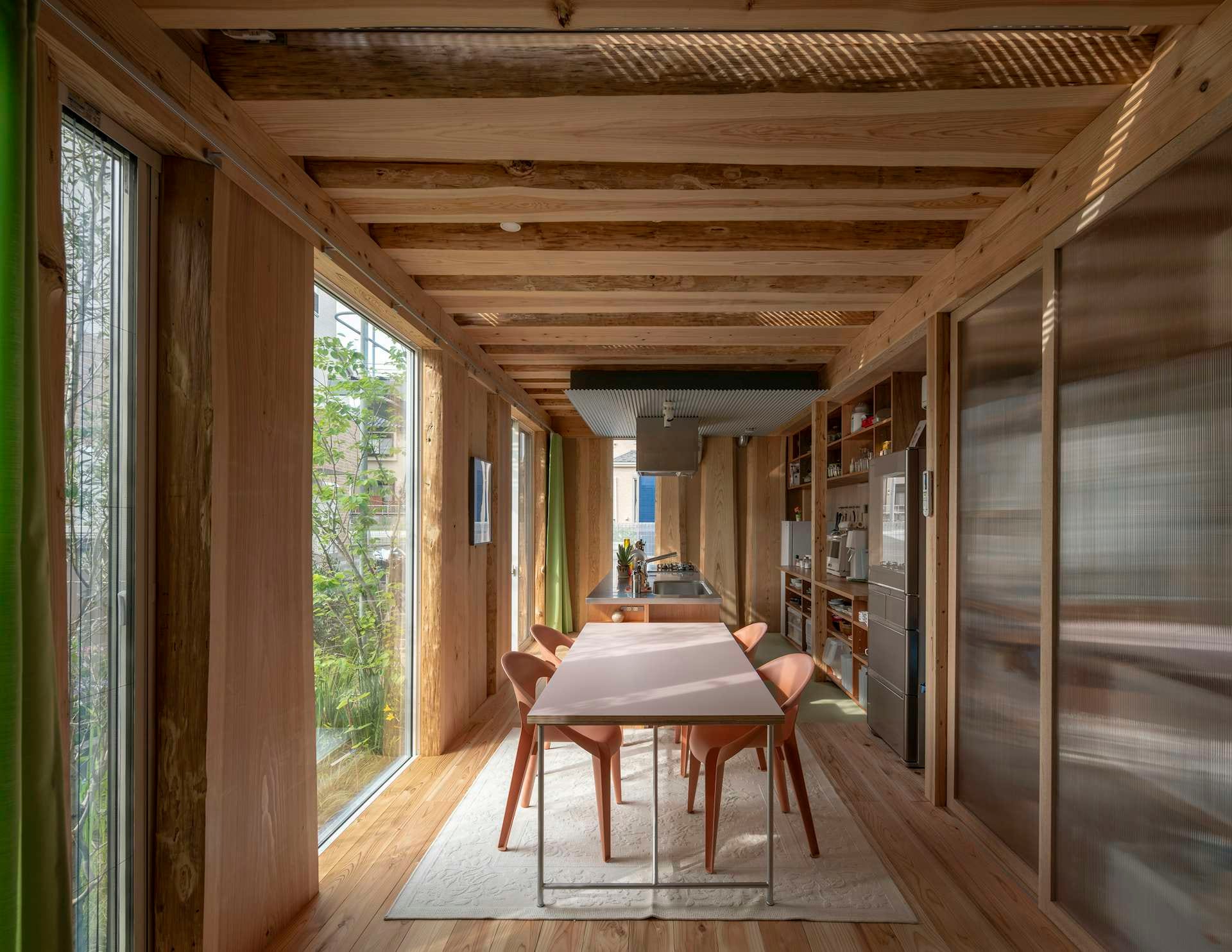
Blink and You Might Miss This Super Skinny Japanese Home on Stilts
By Grace Bernard for Dwell
My take: This reminds me of Chicago’s impossibly tiny bridgehouses over the river downtown, which I have always thought would make glorious vacation rentals.
**Best line: “**Live Sawn House confronts a paradox in contemporary Japanese forestry: thick, high-quality sugi (Japanese cedar) logs are valued less than thinner ones. This inversion stems from postwar reforestation policies and the decline of sawmills capable of processing large timber, leaving mature cultivated trees underutilized. Forestry workers lament that decades of growth are sold cheaply and cut into standardized pieces. Rejecting this logic, the project embraces an alternative: showcasing thick logs in their raw, expressive form using dara-biki (live sawing), a traditional method that reveals each tree’s unique character while maximizing yield and structural integrity.”
Seth Putnam is an editor and writer in Chicago. He lives with his wife, son, and daughter in a 1920s home that is the epitome of a work in progress.
“Instructions for living a life: Pay attention. Be astonished. Tell about it.” —Mary Oliver
Learn to play a musical instrument:
https://youtu.be/R0JKCYZ8hng?si=c9TpOUJiCGSkfG-s
Had no idea Mr. Rogers was polarizing!
Anyway, in the mornings I enjoy the attentive ritual of making tea. Boil the water yourself, sit/stand with it while it heats up, pour and watch the steep. Drink. Repeat.